Data Visibility
NetSuite enables companies to manage the entire business through a single platform. This means that all company data can be stored in one place, within NetSuite, creating a single source of truth for data that matches company-wide.
The #1 Cloud-Based ERP Software
At its core, NetSuite is a cloud-based Enterprise Resource Planning (ERP) platform built by Oracle. It combines financials, CRM, ecommerce, inventory, and more into a unified system, enabling businesses to manage their operations in real time.
This brain is what businesses run on for all facets of their organization, including operations, customer management, sales, marketing, ecommerce, data management, human resources, accounting, project management, website management, supply chain management, and other functions. NetSuite can be customized internally to align with a specific business, and it can also connect to external software through API's and Integrations. What this provides a company is the ability to have vital information at their fingertips to run their business.
Today, NetSuite software provides companies worldwide with scalable tools for growth.

Anchor Group Podcast: Episode 1
NetSuite is the #1 Cloud-based ERP system, but what is an ERP system, you ask? ERP (Enterprise Resource Planning) is a term that refers to a system aiming to integrate all of a company's data. Such data can range from project management, HR, and Marketing to accounting, financial, and inventory management.
In this debut episode of the Anchor Group Podcast, Caleb and Michael break down the fundamentals of ERP systems, focusing on how NetSuite can transform business operations. Whether you're new to ERP or looking to optimize your current system, this episode is packed with practical insights to help you stay ahead in today’s fast-paced world.
Is NetSuite a Good ERP System?
The focus of an ERP is well-defined business rules and the integration of a vast amount of data. However, each company has particularities regarding business rules and the type of data that interests it. Therefore, a good ERP is highly configurable and has well-defined rules for good business management practices, which leads us to NetSuite.
Because it’s all part of one system, users get seamless transaction flows and a unified data model—reducing silos and improving decision-making.

How did NetSuite become Oracle NetSuite?
NetSuite was founded in 1998 and was one of the first vendors to develop web-based business applications. Oracle acquired NetSuite in 2016, integrating ERP, database, and cloud technologies. Oracle NetSuite ERP now combines Oracle’s infrastructure strength with NetSuite’s modular business suite, offering enterprise-grade performance, security, and global scalability.
Since its inception, NetSuite has developed into a comprehensive business management suite and has grown to become the #1 cloud-based enterprise resource planning (ERP) solution, supported by an ecosystem of partners, users, and third-party providers who extend, customize, and integrate NetSuite solutions.
That's where Anchor Group Comes in.

Anchor Group is a small NetSuite partner firm based in the United States! Our team of onshore NetSuite consultants and developers can handle a wide range of NetSuite projects, from full implementations to post-go-live support through managed service plans.
We help businesses utilize NetSuite to its fullest potential, solving their resource planning needs. We do so through consulting, solution design, project management, software coding and development, and implementation. Discover more about our team and the services we provide.
NetSuite enables companies to manage the entire business through a single platform. This means that all company data can be stored in one place, within NetSuite, creating a single source of truth for data that matches company-wide.
NetSuite's unified architecture offers a familiar user interface across all modules, reducing training time and enhancing work efficiency. It also allows users to complete multistep processes from a single application without re-entering or exporting data.
Many "cloud" ERP systems are hosted or hybrid clouds—essentially suitable for on-premises software accessed over the Internet. NetSuite, on the other hand, was born and built for the Cloud.
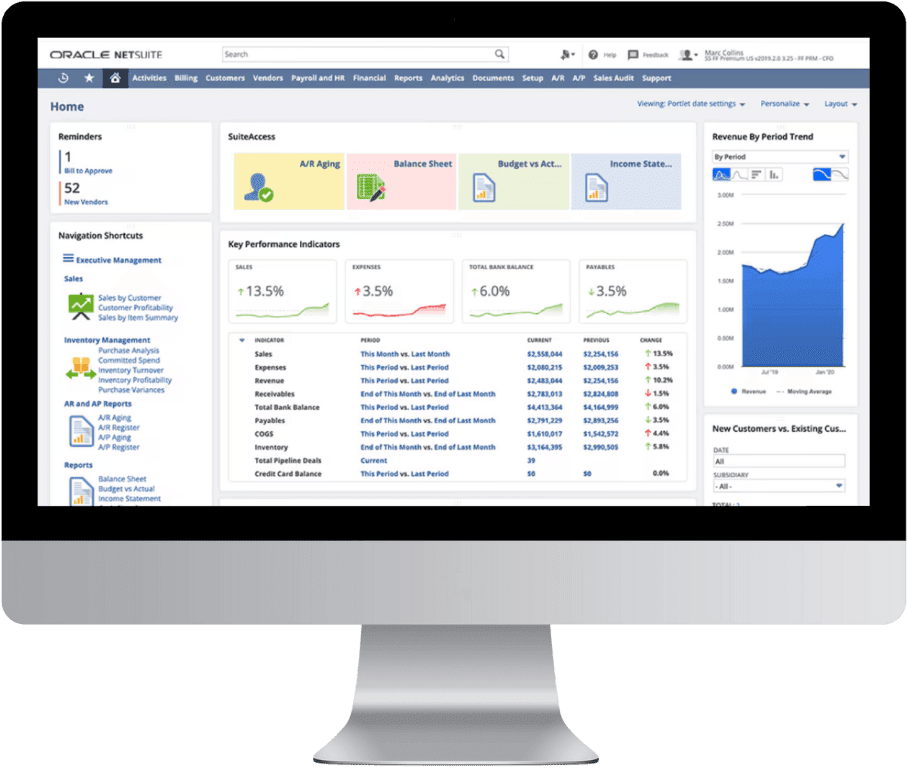
With the help of NetSuite's built-in reporting tools, users can create reports on anything they want to measure or understand. NetSuite also enables companies to create custom role-based dashboards that quickly provide employees, managers, and executives with the information they need to make informed business decisions.
Through its modular structure, NetSuite can meet the needs of businesses across a wide range of industries. Combined with additional agility achievable through customizations, NetSuite can meet the needs of a mid-sized local business and scale alongside the company as it grows into a multinational brand.
NetSuite is a business management software solution owned by Oracle, and is the #1 cloud-based enterprise resource planning (ERP) software. It has many modules that build out a suite of products covering backend business solutions and ecommerce. It's the most popular choice for the mid-market business!
NetSuite is an ERP, which means it is the software that runs the entire brain of your business, from end-to-end, encompassing the entire business process, from sales order to receiving cash, procurement, paying vendors, warehouses, inventory management, work orders, assemblies, and much more.
NetSuite is used to manage all of a business's needs from accounting, reporting, inventory, invoices, marketing, CRM, ecommerce, order management, and human resources. It is the most popular software for operating a business in the mid-market. Typically, when companies outgrow QuickBooks, they switch to NetSuite.
The NetSuite pricing varies significantly based on a company's needs. For example, a large enterprise operating globally and selling products online will require a broader range of features than a company that operates in the U.S. and has not yet entered the ecommerce scene. To learn more about what purchasing NetSuite might look like for your company based on the features and services you need, contact us.
Your business will likely not need an ERP system like NetSuite until you have outgrown another software, such as QuickBooks, or have disparate systems that are negatively impacting your daily business operations. NetSuite is typically too much for companies making <$5 million in annual revenue. NetSuite becomes a viable option for businesses generating $5-10 million annually. Once a company reaches $10-20 million in annual revenue, investing in NetSuite will become easier; however, companies that wait until then to implement NetSuite miss out on numerous opportunities for earlier automation, sacrificing business growth by delaying their NetSuite implementation.
NetSuite is a true cloud ERP—it’s built to run in the cloud from the ground up, not a retrofitted hosted version of on-prem software. It handles upgrades, maintenance, and infrastructure behind the scenes, allowing users to interact via browser or mobile.
Unlike perpetual licenses, NetSuite’s pricing is subscription-based and modular. You don’t pay upfront for infrastructure or hardware—just for the users, modules, and services you need.
Yes—NetSuite scales for small businesses by allowing them to begin with essential modules and expand over time. This allows growing companies to adopt full ERP earlier without overpaying for unused features.
NetSuite goes beyond basic accounting—providing full ERP, inventory control, multi-entity support, customization, analytics, and automation. QuickBooks is strong for small accounting but lacks enterprise capabilities.
Yes—NetSuite often provides demo environments or guided trials so prospective customers can explore its ERP, CRM, and eCommerce features in action.
Why Choose Anchor Group?
How much does NetSuite cost?
NetSuite pricing is modular and subscription-based, not a fixed off-the-shelf price. Your cost depends on:
Because of this flexibility, many businesses engage with a partner to estimate their NetSuite cost based on needs. There is no “one price fits all” plan.

NetSuite’s cloud architecture enables a host of built-in features that differentiate it from traditional on-premise software. NetSuite cloud features include: